
Late Summer is the Fifth Season: Nourishing the Earth Element
I first wrote this in 2011, and I return to it every year because late summer is a key time in Chinese medicine that often gets overlooked, making it essential for seasonal health.
Even if the Western calendar doesn’t mark it, we feel it. The light softens. Cicadas buzz in the trees. Mornings are cooler, evenings come earlier, and there’s a distinct sense that the energy has shifted. It’s not summer anymore, and it’s not yet autumn. In Traditional Chinese Medicine (TCM), this is late summer: the Earth season.
Late Summer in Traditional Chinese Medicine
In Chinese medicine, there are five seasons. Late summer is the Earth element, a time of abundance, ripening, and harvest. It’s the moment when nature’s energy turns inward, preparing for the descent of autumn.
The Earth element in TCM corresponds to the Spleen and Stomach, the organs that transform food into Qi — the life force that fuels every aspect of health. Earth governs digestion, the muscles, lips, and mouth.
When Spleen Qi is strong, we feel grounded, nourished, and compassionate. When Earth is weak, we may experience:
Worry, overthinking, or mental fog.
Digestive problems like bloating, loose stools, or poor appetite
Muscle weakness or fatigue
Sugar cravings or constant snacking
Late summer is the perfect time to strengthen digestion, rebuild Spleen Qi, and realign with the rhythm of the season.
How to Nourish the Earth Element in TCM
To live in balance during late summer:
Eat Spleen-nourishing foods, especially seasonal produce in yellow and orange tones like squash, pumpkin, corn, carrots, and sweet potatoes, to support your health during late summer.
Favor warm, cooked foods. Soups, stews, and porridges ease digestion, while cold and raw foods burden the Spleen.
Align your sleep schedule with the season by going to bed earlier and rising a little later, helping you feel more connected and balanced with the natural flow of late summer.
Practice moderation. Overeating, overwork, or over-giving depletes Earth energy. Center yourself first.
Schedule time to process thoughts and reduce information overload. Limiting screen time and giving yourself space can promote mental clarity and inner calm, supporting your overall well-being.
Late Summer Recipes To Nourish Spleen Qi
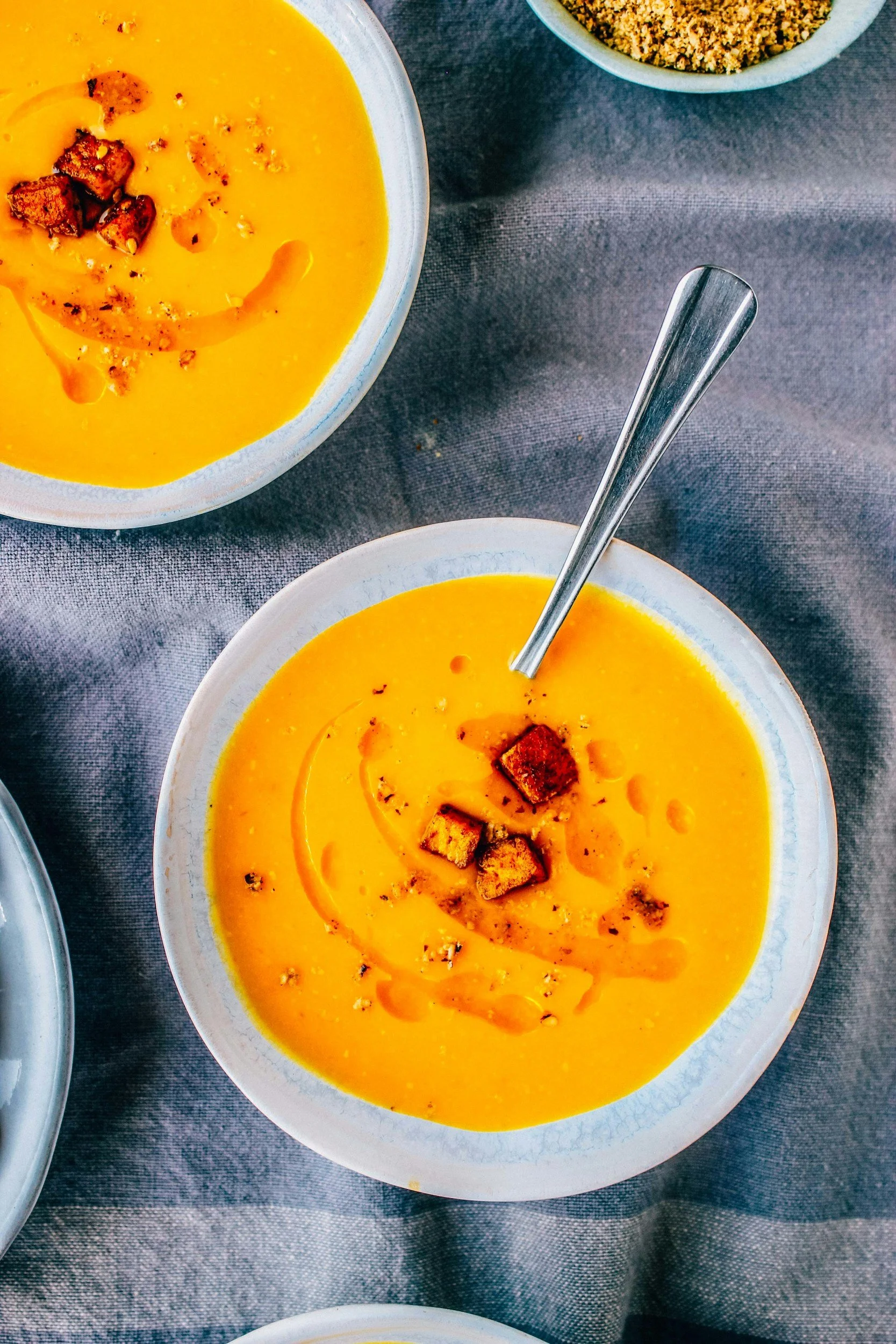
Carrot Soup
Creamy Carrot Soup (Food52 Classic)
Carrots are naturally sweet and grounding—the perfect late-summer food in TCM.
This year, I’m going to spice it up with chili crunch, croutons, and pumpkin seeds.
Ingredients
3 Tbsp unsalted butter
1 onion, thinly sliced
1 bunch fresh sage, leaves only
1 lb carrots, peeled & sliced
3 cups chicken or vegetable stock
1 tsp kosher salt (to taste)
1 tsp white pepper (to taste)
Instructions
Melt butter in a medium pot until frothy and lightly browned.
Add sage leaves, crisp, then remove and set aside.
Add onion; cook until translucent.
Stir in carrots; cook 5 minutes.
Add stock; bring to a boil, then simmer for 30 minutes, until the carrots are tender.
Blend until smooth. Adjust seasoning.
Serve topped with reserved sage leaves.
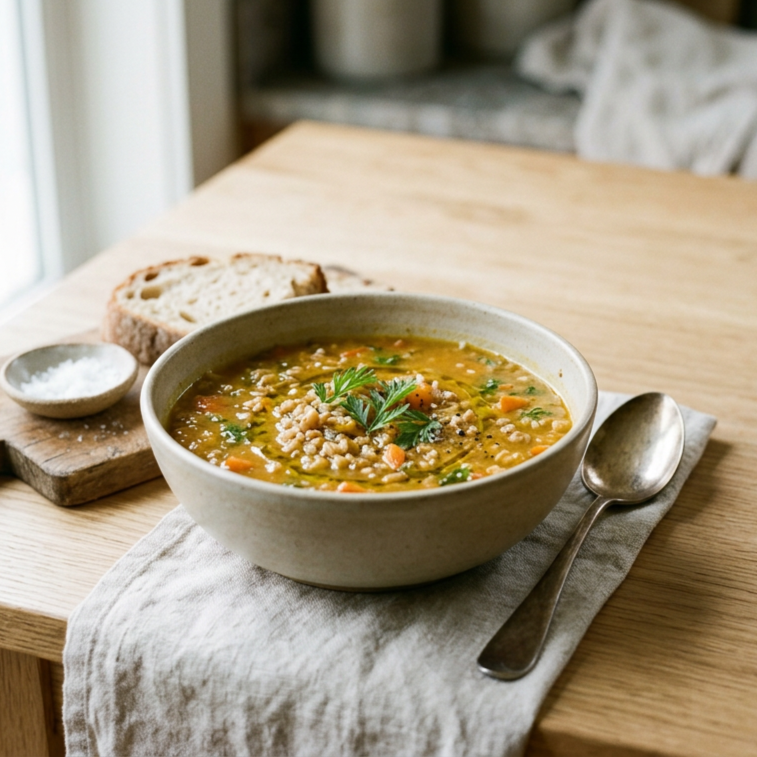
Farro Soup
Carrot Top & Farro Soup
This recipe uses the whole carrot — the root and the greens — for a nourishing, waste-free dish. Gluten-free? Swap farro for millet (an ideal Spleen Qi food).
Ingredients
1 bunch carrots, with tops
½ cup farro (or brown rice/millet)
3–5 garlic cloves
6 cups chicken or vegetable stock
1 parmesan rind (optional). If Vegan, try adding a piece of Kombu for extra umami.
1 cup chopped celery
1 onion, chopped
3–5 Tbsp olive oil
1 cup diced fennel (optional)
1 cup fennel fronds (optional)
Bay Leaf
Instructions
Wash carrot tops well; remove the stems and chop finely. Slice carrots into rounds.
Heat olive oil in a soup pot. Add carrots, onion, celery, garlic (and fennel if using). Sauté 5 minutes.
Stir in farro (or millet) until coated.
Add 4 cups stock and parmesan rind. Season lightly. Simmer 30–45 minutes until grains are tender. Add more stock if needed.
Stir in carrot tops and fennel fronds; simmer another 10–15 minutes.
Remove rind; serve warm.
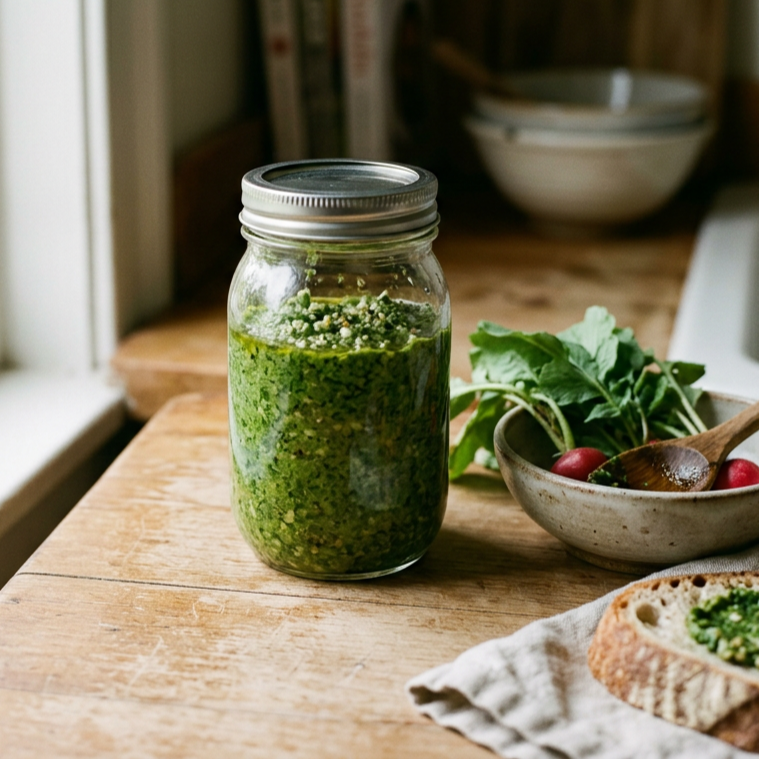
radish leaf pesto
Radish Leaf Pesto
Spicy, peppery, and bright — this balances the sweetness of late summer foods and helps move Qi stagnation. The proportions of basil and radish tops are flexible- base it on your personal preferences or how much of each you have on hand.
Ingredients
3 cups radish leaves, stems removed
1 cup basil leaves
3–4 garlic cloves
½ cup hazelnuts, pine nuts, or pumpkin seeds
½ tsp sea salt
½ cup grated parmesan
½–1 cup extra virgin olive oil
Optional: lemon zest
Instructions
Combine radish leaves, basil, garlic, nuts, salt, and cheese in a food processor.
With motor running, drizzle in olive oil until smooth.
Add lemon zest if desired.
Serve over pasta, eggs, fish, or tofu.
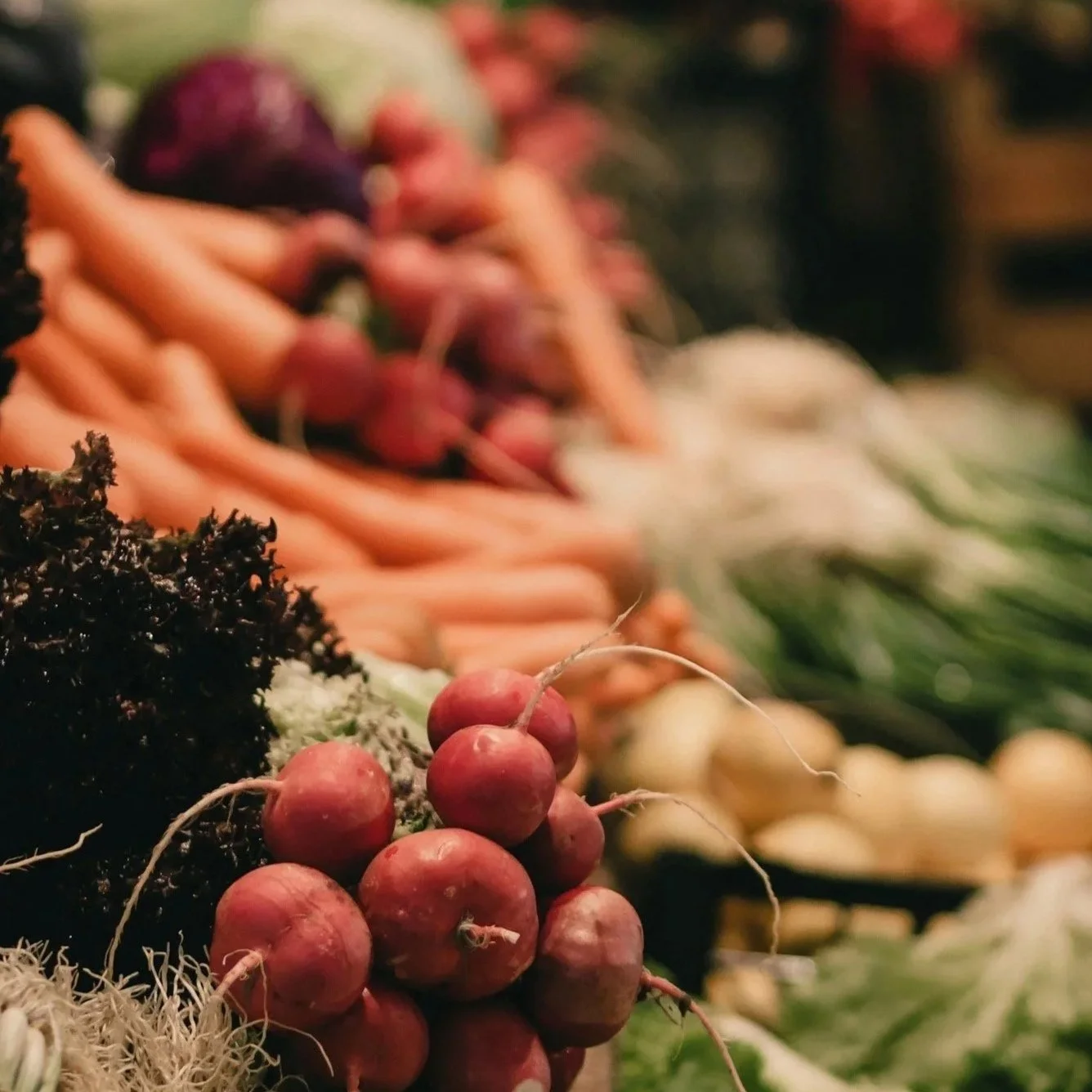
veggies
Roots, Leaves, & Herbal Support for the Spleen
There's a reason two of these recipes use the whole vegetable. Chinese medicine reads a plant by where it grows and what it's shaped like. Roots grow downward into the dark, dense, and starchy, storing the plant's reserves — so they tend to anchor, consolidate, and build. Most of them are sweet, and sweet is the flavor that enters the Spleen and tonifies. Leaves do the opposite work: thin, aerial, exposed to wind and sun, usually bitter or peppery. They disperse and move.
That's the whole logic of a carrot soup with a radish leaf pesto on the side. The root builds; the leaf keeps the building from stagnating. Li Dong-yuan, the 13th-century physician who wrote the definitive text on Spleen and Stomach disorders, framed digestion as exactly this pairing of movements — clear yang rising, turbid yin descending. When that traffic stops, you get the bloating, heaviness, and fog people describe every August.
Food does a lot of this work, but it has limits. An entrenched Spleen Qi deficiency — years of loose stools, exhaustion after eating, appetite that comes and goes — usually needs herbs alongside the diet. The classical formula family here is built on Si Jun Zi Tang Four Gentlemen Decoction, with variations like Liu Jun Zi Tang (Six Gentleman) when phlegm and damp have accumulated, or Shen Ling Bai Zhu San (Ginseng, Poria, Atractylodis Powder), when digestion is loose and watery. Which one fits depends entirely on the pattern in front of me, not on the symptom name.
I work with patients on seasonal diet and herbal formulas both in my Philadelphia practice and by telehealth. If late summer is when your digestion reliably falls apart, that's worth treating rather than waiting out.
Why Late Summer Matters In 2026
When I first wrote about this in 2011, I mentioned “information overload.” More than ten years later, that challenge has exploded. The constant cycle of screens, news, and stress taxes our Spleen and leaves us ungrounded.
Late summer is nature’s reminder to come back to center. By eating Spleen Qi foods, living in harmony with the Earth element, and aligning with seasonal rhythms, we can cultivate stability, balance, and resilience.
This is the power of seasonal eating in Chinese medicine: it nourishes not only the body, but also the mind and spirit.
About Cara Frank, L.OM.
Cara Frank, L.OM., was raised by a health food store in Brooklyn, NY. When she was 8, she cartwheeled 5 miles from Greenwich Village through Soho and Chinatown and across the Brooklyn Bridge. For over four decades, she has had the same crazy passion for Chinese medicine. At 17, she had her first acupuncture treatment. At 20, she enrolled in acupuncture school. In 1998, she went to China to study, where she fell deeply in love with herbs and has never recovered. She is also the president of China Herb Company and China Herb Seminars. You can read her bio.
